Heat Stress at Work: Hydration Is Not Enough
Home » Latest News » Heat Stress at Work: Hydration Is Not Enough
- Sam Houlihan
If you spend time managing safety on site, you don’t need convincing that heat affects people. You see it over the course of a shift. Workers slow down. Focus slips. Tasks that are normally routine start taking longer or need more monitoring.
What’s easier to miss is how early this begins, and how often it’s already happening before anyone feels unwell.
Heat stress is often viewed as a summertime problem, something to manage when temperatures rise. In reality, many work environments generate heat as part of the job. Machinery, hot surfaces, enclosed spaces, and protective clothing all contribute. That means heat exposure can be present even on days that don’t feel extreme.
Once heat starts to affect decision-making and coordination, risk rises quietly. By the time someone realises they need to stop, performance may already be compromised. Hydration plays a critical role in managing this risk, but in many environments it isn’t enough on its own.
It’s equally important to know that not all heat is the same.
The Critical Role of Hydration
Our bodies are remarkable at regulating temperature, and sweating is central to this process. During physical labour, the body cools itself through sweating, which can lead to a loss of electrolytes and body fluid at a rate of 1 – 2.5 litres per hour, depending on the workload, clothing, and environment. In extreme conditions, these losses can be even higher.
Maintaining hydration is crucial for replenishing lost fluids and supporting essential functions, including circulation and mental alertness. Even mild dehydration – a loss of just 1–2% of body water – can impair attention, slow reaction times, and increase the risk of errors in high-risk settings, including those involving vehicles, machinery, or work at height.
For these reasons, access to water and electrolytes, along with education and scheduled breaks, must be a key part of any heat management plan. However, it’s important to remember that hydration alone cannot prevent heat from entering the body, especially in environments with significant radiant heat.
Heat Stress Is a Daily Risk, Not a Seasonal One.
On many sites, heat exposure is built into the task. Workers may be operating near a hot machine, standing on heat-retaining surfaces, working in direct sunlight, or wearing PPE that restricts airflow. These conditions don’t disappear outside of summer, and neither does the risk.
Heat stress rarely announces itself. It tends to build gradually, showing up as fatigue, slower reactions, or lapses in concentration as the shift progresses. These early changes are often subtle, but they’re where incidents start to become more likely.
From a safety perspective, this matters because heat stress doesn’t always appear on incident reports as the root cause. It often sits in the background, contributing to vehicle incidents, manual handling injuries, or procedural errors that are recorded under a different category entirely.
Early Heat Stress Signs
Most people associate heat stress with severe outcomes. In practice, the greatest safety risk sits well before that point.
You might notice workers tiring earlier than expected, taking longer to complete familiar tasks, or missing small details that normally wouldn’t be an issue. In isolation, these things may seem minor. In higher-risk environments, they can make the difference between a safe shift and a near miss.
This is why prevention matters. Once someone feels noticeably affected by heat, their performance has usually already dropped. Managing heat stress effectively means limiting heat build-up before it starts to affect how people work.
Why Hydration Helps, and Where It Stops Helping
Most heat stress plans quite rightly prioritise hydration. Fluids support circulation, help regulate body temperature, and reduce fatigue. During physical work, sweating is one of the body’s main ways of releasing heat, and electrolyte hydration supports that process.
The limitation is that hydration only helps the body cope with heat. It doesn’t reduce how much heat workers are exposed to. If the environment itself is adding heat, through hot surfaces, equipment, or direct sun, the body is still playing catch-up.
Hydration supports the body’s response to heat, but it does not prevent heat absorption. When radiant heat exposure is present, the body can continue to gain heat faster than it can release it, even when fluid intake is adequate.
Relying on hydration alone has several limitations:
- Drinking water does not reduce heat absorbed from hot surfaces or sunlight.
- Sweat evaporation becomes less effective in high humidity or low airflow.
- Required PPE can restrict airflow and trap heat close to the body.
- Early signs of heat strain may not be immediately recognised.
This is where some heat stress plans quietly fall short. Workers may be doing the right thing, drinking fluids and taking breaks, while heat load continues to build.
As a result, a worker may remain well hydrated while still experiencing increasing thermal strain. This highlights the need for additional controls that actively reduce heat exposure rather than only addressing dehydration.
Radiant Heat vs. Ambient Heat: What’s the Difference?
Not all heat exposure behaves the same way, and this distinction is important when deciding which controls are actually effective.
Ambient heat is the temperature of the air around the worker. On warm days or in enclosed spaces with limited ventilation, the body relies heavily on sweating to cool down. In these situations, hydration, airflow, shade, and rest breaks do a lot of the heavy lifting.
Radiant heat is different. It comes from hot surfaces or heat-producing equipment and transfers directly to the body. Asphalt, concrete, metal structures, furnaces, engines, welding equipment, and direct sun all contribute. Even when the air temperature feels manageable, radiant heat keeps adding to the body’s heat load.
The simplest way to think about it is this:
- Ambient heat makes it more difficult for the body to regulate its own temperature.
- Radiant heat keeps adding heat that the body then has to deal with, and when radiant heat is present, hydration alone struggles to keep up.
To manage heat risk effectively, it’s crucial to know that not all heat is created equal. Understanding the difference is key to keeping workers safe:
| Type | Description | How It Heats You | Common Examples |
| Ambient Heat | The temperature of the surrounding air. | Your body is warmed by the air around it. | The temperature reading on a weather app or thermostat. |
| Radiant Heat | Heat transferred directly from a hot object to you through infrared waves. | Your body absorbs heat directly from the source, regardless of the air temperature. | The warmth you feel from the sun, a hot engine, asphalt, or a furnace. |
Think of standing near a campfire on a cold night. The air temperature (ambient heat) is low, but you feel warm because the fire is emitting radiant heat. The same principle applies on a worksite. A manager might see a safe temperature on the thermostat, while workers nearby feel the hot air circulating.
Why Well-Hydrated Workers Can Still Be at Risk
One of the most common assumptions on site is that if workers are drinking enough, heat stress is under control. In radiant heat environments, that assumption can create a false sense of security. Early signs of heat strain can be easily missed, particularly during busy operations.
Heat strain rarely starts with obvious or severe symptoms. In most cases, the early signs are subtle and behavioural rather than medical, which is why they’re easy to miss during busy operations.
Common early signs of heat strain include:
- Slowing work pace earlier in the shift than expected
- Taking longer to complete routine or familiar tasks
- Needing more frequent pauses or rest without a clear reason
- Reduced concentration or difficulty following instructions
- Missing steps in procedures or needing tasks double-checked
- Poorer judgment or taking shortcuts they would normally avoid
- Persistent sweating without feeling any relief
- Flushed skin or ongoing discomfort despite drinking fluids
- Describing feeling “overheated”, “drained”, or unusually fatigued
Importantly, these signs can appear even when hydration is adequate. A worker may be drinking regularly and following guidance, yet still absorbing more heat than their body can release, particularly in radiant heat environments.
Drinking fluids supports the body’s cooling response, but it doesn’t block heat coming from hot surfaces, equipment, or direct sun. In these environments, workers can continue to absorb heat throughout the shift, and this effect is often exacerbated by high humidity, limited airflow, or PPE that traps heat close to the body. The result is that a worker may be fully compliant with hydration practices and still experience increasing thermal strain. This is where hydration alone leaves a gap.
Where Cooling PPE Earns Its Place.
Cooling PPE exists to close that gap. It’s not about comfort for comfort’s sake. It’s about reducing heat build-up where work is actually happening.
By helping lower skin temperature and manage heat at the point of exposure, cooling PPE supports the body’s natural cooling process. That means less strain, more consistent performance, and fewer moments where fatigue or discomfort start to affect focus.
Used properly, cooling PPE doesn’t replace hydration or breaks. It works alongside them, adding another layer of protection in environments where heat exposure can’t be eliminated.
How Cooling PPE Works in Real Conditions.
Cooling PPE uses established cooling methods that are suited to active work environments where heat exposure cannot be fully eliminated.
Within the Ergodyne Chill-Its Cooling PPE range, two main cooling approaches are used, depending on the work environment and conditions.
Evaporative Cooling
Evaporative cooling works best where there is movement or reasonable airflow. These products activate with water and use evaporation to draw heat away from the body, mirroring the body’s natural cooling process.
In practical terms, this includes cooling towels, neck and face wraps, and cooling hard hats that can be easily reactivated during a shift, suitable for tasks where heat exposure varies throughout the day. This approach is commonly used in outdoor work, such as road construction and civil works, where direct sunlight and heat reflected from asphalt can quickly increase thermal strain, even when hydration practices are well-managed.
Phase Change Cooling
Phase change cooling is better suited for enclosed or low-ventilation environments, or for situations where workers spend extended periods near radiant heat sources. These products use specialised cooling packs that maintain a consistent temperature without relying on airflow.
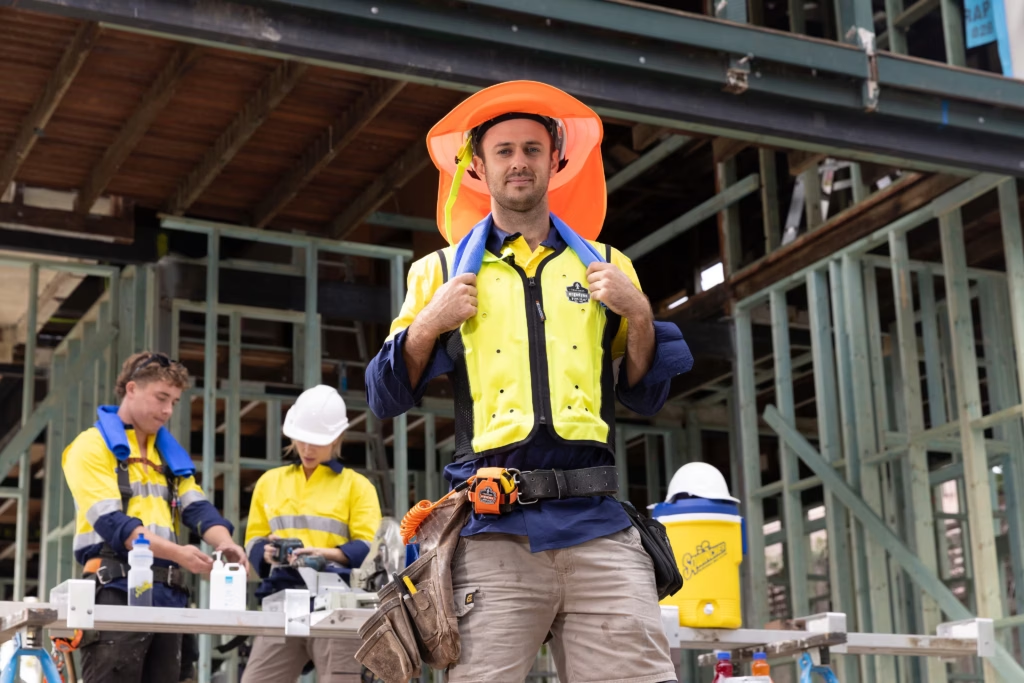
Cooling vests and hats in the Chill-Its range are commonly used in manufacturing, processing, and plant environments where radiant heat from machinery or equipment is present despite controlled air temperatures. They are also effective in utilities, transport, warehousing, and maintenance tasks where protective clothing restricts airflow and heat builds up over longer shifts.
Across the range, cooling PPE complements existing controls rather than replacing them and is designed to be worn where heat build-up is most noticeable, typically around the head, neck, and torso. Products are built to integrate with existing PPE and workwear, allowing them to be used on site without interfering with mobility, work tasks or safety requirements.
Matching the cooling PPE to the conditions workers are exposed to helps close gaps that hydration alone cannot address, supporting safer and more consistent performance on site.
Prevention Is Easier to Manage Than Recovery.
Many traditional approaches to heat management rely on recovery. Workers are encouraged to drink fluids as soon as they feel hot or fatigued. While recovery remains important, it assumes symptoms will be recognised early and addressed promptly. But recovery-based heat controls are reactive. They depend on workers recognising strain early and stepping away from tasks, and on supervisors having the time and capacity to respond in the moment. On busy sites, that assumption does not always hold.
The impact on the business is often immediate. Concentration drops. Work slows. Errors become more likely. Supervisors are pulled into managing disruption instead of keeping operations running smoothly.
When recovery is the main control, interruptions become part of the shift. Workers stepping away mid-task affects coverage and sequencing. If an incident occurs, the consequences extend further through medical response, investigations, reporting, and lost time. These impacts are operational as much as they are financial.
Over time, unmanaged heat exposure also shapes workplace culture. When discomfort is something people are expected to push through, fatigue becomes normalised, and trust erodes. Workers are less inclined to speak up if they believe heat risk is accepted rather than actively managed.
Prevention avoids this pattern. Controls that limit heat buildup during work are easier to plan for and apply consistently. Cooling PPE supports this approach by reducing heat exposure at the point of work, rather than relying on recovery after performance has already been affected.
From a safety and operational standpoint, prevention is not just more effective. It is simpler to manage and more reliable over time.
Putting Heat Stress Prevention into Practice.
Hydration is essential, but it does not address how heat is generated and absorbed on many worksites. Where radiant heat is present, relying on hydration and recovery alone places too much responsibility on the worker rather than the system around them.
Cooling PPE offers a practical way to close that gap. Used alongside hydration and planning, it helps reduce heat build-up during work and supports a more consistent, controlled approach to managing heat stress.
For safety and operations leaders, prevention is simpler to manage than recovery. Anticipating heat risk helps protect concentration, judgement, and physical endurance before performance is affected, reducing disruption across the shift.
By understanding how different types of heat affect the body and incorporating preventative tools such as cooling PPE, you can strengthen your existing heat stress controls and support safer, more productive work environments.
To learn more or to request samples of the Ergodyne Chill-Its Cooling PPE range, contact Pryme for guidance based on your work environment, contact Pryme.